What Happens to Babies Born to Women in Prison?
South even months meaning, hands cuffed and anxiety bound, Sophia Casias shuffled across the floor at the Bexar canton adult detention center in San Antonio, Texas, on March 2017. A guard at stood in front end of her, holding the chain connected to Casias's handcuffs.
Casias couldn't proceed her remainder though and crumpled on to the wet cement floor. She sobbed and felt as if she couldn't breathe. She would later realize that she had felt the same manner when multiple family members sexually assaulted her as a child.
In her tertiary trimester, Casias, who was jailed for shoplifting – a crime she says she committed to feed her heroin habit – recounted that after she fell "a female person baby-sit grabbed me by the hair and was making me become upwardly. She was screaming: 'Bitch, get upward.' Then she said, 'That is what happens when yous are a fucking junkie. You shouldn't be using drugs or y'all wouldn't exist in here.'"
The jail put Casias in bondage a twelvemonth and a half earlier the passage of the Start Step Human action in December 2018, a federal law that prohibits some of the most punitive measures against prisoners, including shackling of pregnant women.
Only the recently enacted federal legislation fails to protect women in state prisons and county jails – a population that accounts for 85% of incarcerated women in America, co-ordinate to a 2018 report by the Prison Policy Initiative.
This means thousands of significant inmates remain at the mercy of guards who tin can cull exactly how to control their every move – also as the movement of their unborn children.
"We dehumanize this group of women to such an extent that nosotros don't see how wrong this is – but how unnecessary and cruel it is," says Lorie Goshin, acquaintance professor at Hunter-Bellevue School of Nursing in New York and the pb investigator of a contempo study nigh the treatment of incarcerated pregnant women.
Seventy-four percent of respondents in the 2019 study had cared for incarcerated pregnant or postpartum women. Of those women, 61% of the time, the reason given for shackling was not because the prisoners posed a risk to others, or a flight risk, only simply because "at that place was a dominion or protocol" supporting shackling.
Currently, 23 states, says Lauren Kuhlik, Equal Justice Works fellow at the ACLU'southward National Prison Project, do non have laws against shackling of incarcerated meaning women, despite a 2010 United Nations dominion that "instruments of restraint shall never be used … during labour, during birth and immediately after birth".
Meanwhile, many prison employees lack understanding of an inmate's legal rights. Non-for-profits try to fill the gap by distributing pamphlets to inmates and in support groups, explaining anti-shackling laws.
To convolute matters more than, the federal government does not require prisons or jails to collect data on pregnancy and childbirth among female person inmates. A bill introduced in September 2018 would accept required such data drove. However, no action was taken on the bill.
Even the definition of shackling varies. Some states, such as Maryland and New York, ban all restraints immediately before and later birth, though there are exceptions in extraordinary circumstances. Other states, such as Ohio, let meaning women to exist handcuffed in the front end of their bodies, as opposed to behind their bodies, which is thought to exist more than destabilizing.
So in that location is the delineation betwixt shackling during pregnancy, active delivery and postpartum. Individual state laws are filled with nuances. As of 2017, Rhode Island is the only state that has what is chosen "a individual right of action", an enforcement mechanism assuasive the illegally shackled woman to sue for monetary bounty.
The one constant: the acute psychological trauma that shackling inflicts.
"Women subjected to restraint during childbirth report severe mental distress, depression, anguish, and trauma," states a 2017 written report from the American Psychological Clan.
"Women who get locked upwardly, tend on average to have suffered many more childhood traumas, says Terry Kupers, Physician, a psychiatrist and the author of the volume Solitary: The Inside Story of Supermax Isolation and How Nosotros Can Abolish It. He implores prison staffs "to be very conscientious that nosotros exercise not re-traumatize them. Considering re-traumatization makes weather condition like post-traumatic stress disorder much worse."
Amy Ard, executive director of Motherhood Across Bars, a non-for-profit in Georgia, worries that the trauma of shackling takes a price on the cocky-image of new mothers. Inevitably, this question looms in the minds of the women Ard works with: if I am someone who needs to exist chained, how can I look to also see myself as someone capable of protecting my child?
H arriette Davis, 64, once an inmate at the California Establish for Women in Corona, is now an anti-shackling advocate and remembers well the trauma of being handcuffed to a hospital bed before giving birth to her girl 36 years agone. The attending doctor told the guard to remove the shackles, Davis says, so that Davis could move freely, helping her baby travel more easily downward the birth canal.
"She's not going anywhere," Davis says the doctor bodacious the guard.
In the final hour before her daughter was born, the baby-sit finally removed the restraints.
Davis bursts into tears every bit she speaks by phone from her habitation in Berkeley, California. "It'south inhuman and it's not necessary and information technology's emotionally and mentally unhealthy," she says.
Davis, a black adult female imprisoned for voluntary manslaughter of her abuser, says the shackling brought up the historical enslavement of her people, as well as continued injustices confronting them.
The The states incarcerates more people than any other country in the globe. Women have become the fastest-growing gender group within that population, where blackness women are virtually twice as likely to be incarcerated as white women, co-ordinate to a 2019 written report based on data from 2017 from the Sentencing Project, a research and advocacy grouping focusing on racial disparities in crime and punishment.
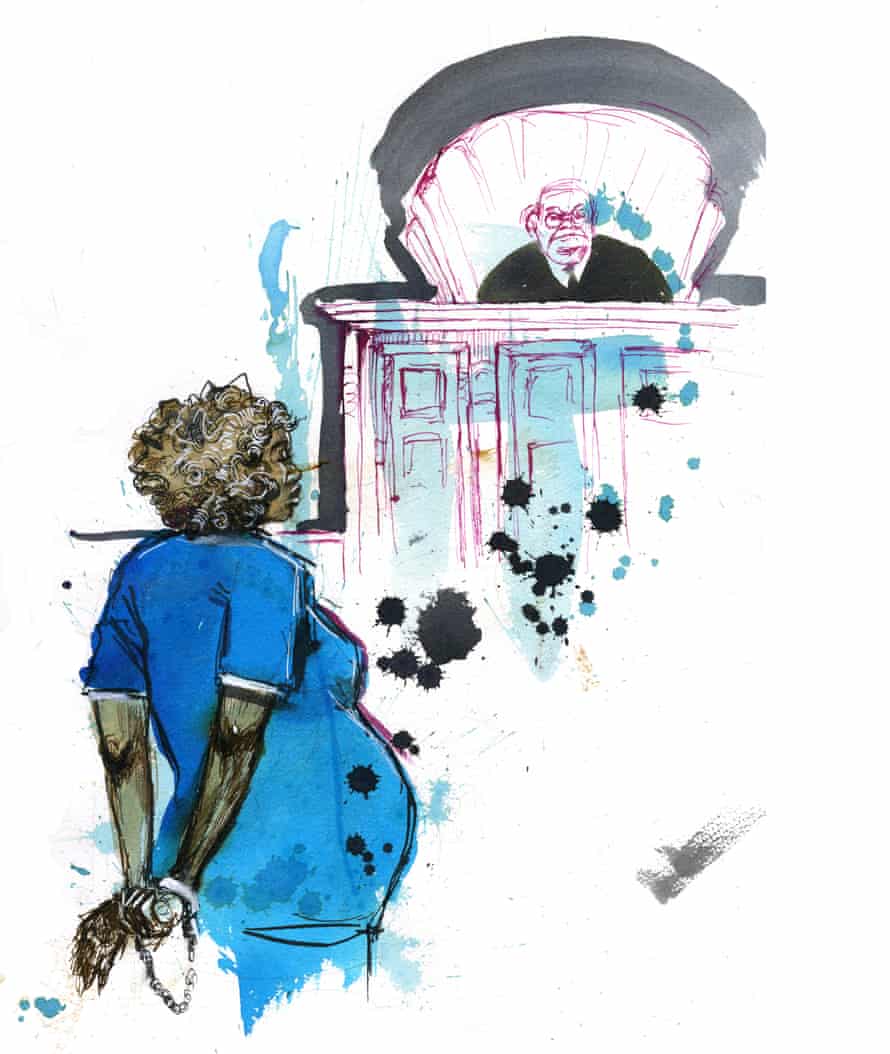
Advocates for prisoners bespeak to some modest successes in their efforts to alter castigating land and local laws. On i October, an anti-shackling law for significant women took result in Georgia, Firm Bill 345, preventing shackling from the second semester through vi weeks postpartum. That bill's passage came merely months after Danielle Edwards stood earlier a judge in Walton canton, Georgia, shackled, meaning and powerless.
Edwards, who was jailed for possession of methamphetamines and has ane prior arrest for drug possession, says her addiction was an attempt to numb the longstanding pain of her grandfather's death when she was five, and and so a yr after that, the sexual attack committed against her, and so the abusive relationship she found herself embroiled in as an developed. Edwards says she briefly beat out dorsum the addiction. But then her granddad's married woman died and "I jumped right back into the drugs," she says.
In the county jail, Edwards, 32, says another inmate threatened her and Edwards was put in 22-60 minutes isolation cell. When she was taken to and from courtroom hearings and doctors' appointments, she was shackled, including leg irons and handcuffs. To prevent the metal around her ankles from cutting into her peel, Edwards wore two pairs of socks. Still, the shackling terrified her.
"It's all very confining, uncomfortable and common cold," she says. "And it'south scary because when your feet have that limited mobility – you don't know if you are going to misstep and fall on your stomach."
She says that when she stood in her navy blue jumpsuit in front of the gauge, she was eight and a half months pregnant. He looked over her charge and a sinking feeling overtook her, Edwards says. She pleaded with him to ship her to rehab instead of prison. That way, she thought, she could go along her baby subsequently the birth.
"And I'thou standing at that place in shackles and in one case I asked him for that adventure he said: 'Practice you really retrieve I am going to let you lot walk out of this court? Absolutely not.'"
-
Lori Yearwood is a contributing editor at the Economic Hardship Reporting Project. Her work has appeared in the Washington Post, Slate, CNBC, the San Francisco Relate and the American Prospect, as well every bit other publications.
Source: https://www.theguardian.com/us-news/2020/jan/24/shackled-pregnant-women-prisoners-birth
0 Response to "What Happens to Babies Born to Women in Prison?"
Post a Comment